Fibonacci Retracement has emerged as a popular technical analysis tool in cryptocurrency trading, offering traders a systematic approach to identifying potential support and resistance levels. While its effectiveness remains debated, understanding how this mathematical approach works and its practical applications can provide valuable insights for both novice and experienced traders.
The Fundamentals of Fibonacci Retracement
Fibonacci Retracement is based on the mathematical sequence first presented by Leonardo Fibonacci in the 13th century, where each number is the sum of the two preceding ones (0, 1, 1, 2, 3, 5, 8, 13, 21, etc.). The key Fibonacci ratios used in trading are 23.6%, 38.2%, 50%, 61.8%, and 100%, derived from relationships between these numbers. When applied to cryptocurrency price charts, these levels are drawn between major peak and trough points to identify potential areas where price might reverse direction.
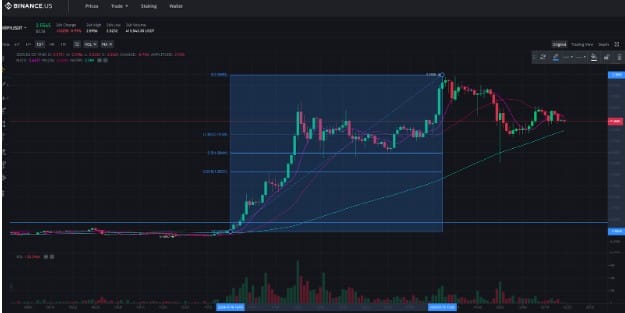
In cryptocurrency trading, traders use these levels to predict where a price correction might end after a significant move. For instance, XRP price increased from $0.57 in early November 2024 to $3.38 on January 15, 2025 according to Binance charts. From this high, XRP has pulled back to the 38.2% retracement level. Traders could look for this support level to hold for another rally higher.
Advantages in Cryptocurrency Trading
One of the primary benefits of Fibonacci Retracement in cryptocurrency trading is its ability to provide objective entry and exit points. Unlike subjective analysis methods that rely heavily on individual interpretation, Fibonacci levels offer precise price points for trading decisions. This objectivity can be particularly valuable in the volatile cryptocurrency market, where emotional trading often leads to poor decisions.
The tool’s versatility across different timeframes makes it especially useful for cryptocurrency traders. Whether analyzing short-term price movements or long-term trends, Fibonacci levels can help identify potential reversal points. This flexibility allows traders to align their trading strategy with their preferred investment horizon.
Another advantage is the tool’s self-fulfilling prophecy aspect. As many traders watch these levels, they often become psychological price points where buying or selling pressure naturally accumulates. This phenomenon can make Fibonacci levels particularly effective in cryptocurrency markets, where technical analysis plays a significant role in trading decisions.
Limitations and Drawbacks
Despite its advantages, Fibonacci Retracement has several limitations that traders should consider. The most significant criticism is the lack of scientific evidence supporting its effectiveness. While the Fibonacci sequence appears in nature, its application to financial markets is based more on observation and trading psychology than mathematical certainty.
The tool’s reliability can also be inconsistent in the highly volatile cryptocurrency market. During periods of extreme market sentiment or significant news events, prices may completely ignore Fibonacci levels, leading to false signals and potential losses. This unpredictability is particularly pronounced in smaller cryptocurrency markets with lower liquidity.
Another challenge is the subjective nature of choosing the peak and trough points for drawing Fibonacci levels. Different traders might select different points, leading to varying retracement levels and potentially conflicting signals. This subjectivity can make it difficult for traders to develop consistent trading strategies based solely on Fibonacci analysis.
Challenges to Mass Adoption
Several factors have hindered the widespread adoption of Fibonacci Retracement in cryptocurrency trading. First, the complexity of understanding and properly applying the tool can be intimidating for newcomers to technical analysis. Unlike simpler indicators like moving averages or relative strength index (RSI), Fibonacci Retracement requires more technical knowledge and experience to use effectively.
The cryptocurrency market’s 24/7 nature and high volatility also present challenges. Traditional market patterns and technical analysis tools may behave differently in this environment, making it harder to rely on Fibonacci levels consistently. The lack of standardization in how different trading platforms implement Fibonacci tools can also create confusion and inconsistency in analysis.
Additionally, the growing influence of algorithmic trading and artificial intelligence in cryptocurrency markets may reduce the effectiveness of traditional technical analysis tools like Fibonacci Retracement. As markets become more sophisticated, the simple patterns that technical analysis relies on may become less reliable.
Practical Implementation
For traders interested in using Fibonacci Retracement, successful implementation often requires combining it with other technical indicators and fundamental analysis. Using multiple timeframes and confirming signals with volume analysis can help improve the tool’s reliability. Risk management remains crucial, as no technical analysis tool is infallible.
Conclusion
While Fibonacci Retracement has its critics, it remains a valuable tool in the cryptocurrency trader’s arsenal when used appropriately. Its ability to provide objective price levels and identify potential reversal points can complement other analysis methods. However, traders should approach it as one of many tools rather than a standalone solution for trading decisions.
As cryptocurrency markets continue to evolve, the effectiveness of Fibonacci Retracement may change. Successful traders will need to adapt their use of this tool alongside emerging technologies and changing market dynamics. Understanding both its potential and limitations will be key to using Fibonacci Retracement effectively in cryptocurrency trading strategies.
Read More


Do you invest in digital money such as Bitcoin or Ethereum? If so, then…

Cryptocurrency had a banner year in 2020. Bitcoin, in particular, increased significantly in value in…


If you thought online securities trading was popular because of the low commissions, easy access…

In today's global market, it's essential that you have the tools you need to be…

Many people realize that timing plays a big role in investment success. Choosing the right…

Financial news moves fast, and headlines often tempt investors to make snap decisions. A market…
Comments