
Diversification is an important investment strategy to protect your portfolio, especially during economic recessions. With stock prices taking a dive and rising inflation on the horizon, many investors are looking for a more conservative approach. Bonds are one type of asset that can minimize losses, limit your exposure, and create a more balanced portfolio to carry you through market downturns. However, it can be difficult to know which ones best suit your strategy. Considering the impending economic conditions, here are a few ways people are capitalizing on I bond interest rates.
What Are I Bonds?
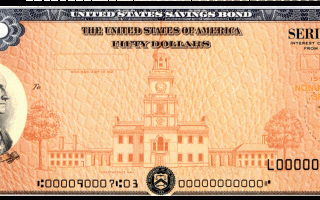
In 1935, the U.S Treasury started a savings bond program to encourage citizens to build their savings and invest their assets with the government. Although savings bonds are no longer printed on paper or available for purchase at local banks, you can still buy government bonds and securities through the official website. While many new investors choose EE savings bonds for their guaranteed returns, I bonds have been receiving a lot more attention recently.
Prior to 2021, many investors had never heard of U.S. Series I savings bonds until they started to yield high returns. For those who aren’t familiar with them, I bonds are a type of savings bond that offers a fixed interest rate with an additional adjustor for inflation. In fact, they are one of the few assets that account for it and protect your money from devaluation. When inflation goes up, so do the interest rates they payout.
They reach full maturity after 30 years and earn compounding interest based on the adjusted rate which is revised twice a year. However, you must hold them for at least a year before you can cash them out. And if you cash them out before five years, you will forfeit three months’ interest as a penalty. On the other hand, if you hold them for the duration and own them during periods of high inflation, I bonds could yield higher rates than any bank, brokerage, or other investments out there.
Earning I Bond Interest Rates
When you purchase I bonds, you begin earning interest the day you buy them. And, they continue to accrue interest until they reach maturity or you cash them out, whichever comes first.
I bond interest rates are calculated with an adjusted formula to find the composite rate. The actual interest that you earn depends on two factors: the fixed-rate and the inflation rate. Investors know the fixed rate at the time of purchase, and this will never change for the life of the bond.
However, the inflation rate is assessed every 6 months (May 1 and November 1) and often fluctuates. The U.S. Treasury determines current inflation rates based on the Consumer Price Index for all Urban Consumers (CPI-U) since many consider this a better gauge of consumer spending. When they apply the new rate, the interest also compounds and is added to the bond’s principal. Then, you continue earning interest on the new amount.
When you combine these two factors, you find the composite rate.
Composite rate = [fixed rate + (2 x semiannual inflation rate) + (fixed rate x semiannual inflation rate)]
I Bonds vs EE Bonds
When you compare I bonds and EE bonds side by side, there are many similarities between the two. Both are sold at face value and accrue interest for 30 years. And, interest rates for both types of bonds compound semi-annually. Furthermore, they have the same requirement for how long you must hold the bond ( 1 year) and penalties for cashing out before 5 years (3 months’ interest). Don’t forget they are both exempt from state and municipal taxation, and entirely tax-exempt when used to pursue higher education.
However, there are some key differences that could affect your total returns. First and foremost, EE bonds guarantee to double the return on your investment when you hold them for 20 years. Unfortunately, you won’t get the same guarantee with I bonds. However, I bond interest rates protect you against inflation with the adjusted rate. Meanwhile, EE bonds will maintain the same fixed rate for the entire time you own it.
There is also a difference in the maximum annual limits you can purchase. While the U.S. Treasury caps individual purchase of EE bonds at $10,000, you can purchase an additional $5,000 in I bonds through your tax return. So, if you are looking to invest the largest amount, I bonds may be the better option for you.
I Bond Interest Rates Now
In November 2021, the U.S. Treasury set the inflation rate at 3.56%. Since the rate doubles for the first six months you own the bond, the current composite rate is 7.12%. Any bonds purchased between November 2021 and April 2022 will lock in this rate for as long as you hold the bond.
However, there is only a month left to guarantee this interest rate. On May 1, the government will reassess and apply the new inflation and interest rates. No one knows what the new rate will be. But, many investors suspect that inflation will continue to rise which could yield even higher returns.
Where Can You Purchase I Bonds?
While the U.S. Treasury sets an annual limit of $10,000 for I bonds, you can use your tax returns to purchase $5k more. If you decide to receive part of your refund in savings bonds, you will need to include Form 8888 with your return.
If I bonds seem like a good addition to your portfolio, you can purchase them directly through TreasureDirect.gov. The government issues the bonds electronically and you can only redeem them from the U.S. government. However, if you still hold paper bonds, you can cash them in at your local bank.
For more conservative investors and those who are looking for low-risk investments to protect their assets, I bond interest rates offer more security than other types of assets. However, before you make any major decisions, you should discuss them with your financial advisor to see how savings bonds would fit into your investment strategy.
Read More
- I-Bond
- Weekly Wrap: I Bonds, Side Hustles, and Dwindling Savings
- 10 Reasons to Consider Investing in Savings Bonds with TreasuryDirect
Come back to what you love! Dollardig.com is the most reliable cash-back site on the web. Just sign up, click, shop, and get full cashback!

Jenny Smedra is an avid world traveler, ESL teacher, former archaeologist, and freelance writer. Choosing a life abroad had strengthened her commitment to finding ways to bring people together across language and cultural barriers. While most of her time is dedicated to either working with children, she also enjoys good friends, good food, and new adventures.
Read More

It’s a hard time to look for work in America, and many Americans are looking.…

Retail Play Some analysts are singing the blues over retail stocks. Their version of “Deck…

Housing Market Peaking? Home sales continue at record levels. However, prices show signs of easing…

Metaverse — The New Reality You’re showing friends around your new corner office in the…

Whether it is an influencer on Reddit or YouTube or professional traders and institutions…

Being smart with your money means that you pay attention to earning, budgeting, saving, investing,…
Comments