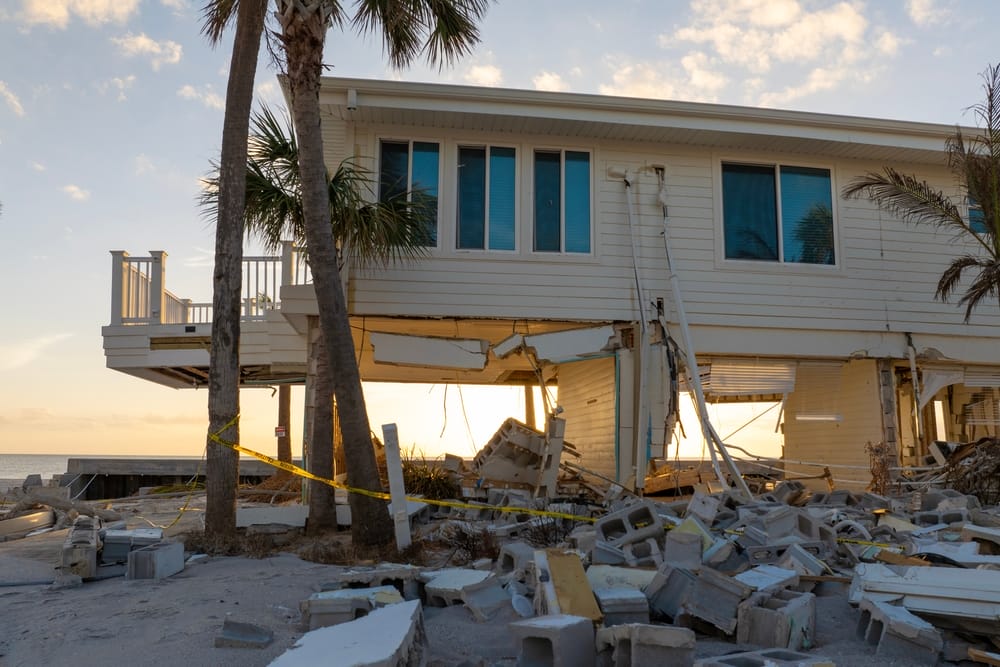
If you live along the Gulf Coast, the Atlantic seaboard, or in the wildfire-prone hills of the West, you probably view your homeowners’ insurance policy as a high-priced security blanket. However, as we settle into 2026, many retirees are discovering that this blanket is feeling increasingly threadbare. Insurance claim denials are reaching record highs in storm-prone regions as carriers struggle with what industry experts call a “landscape of permanent loss.”
With catastrophic claims now making up nearly 46% of all industry losses, insurers have shifted their business models. They aren’t just raising premiums; they are aggressively tightening the “fine print” to limit their exposure. For seniors living on a fixed income, a denied claim for a roof or a flooded basement isn’t just a nuisance—it’s a financial catastrophe. If you want to ensure your next claim actually gets paid, you need to understand the new “denial tactics” being used in 2026.
The “Pre-Existing Wear and Tear” Loophole
The most common reason for insurance claim denials today isn’t the storm itself—it’s the condition of your home before the clouds gathered. Insurers are increasingly using high-resolution satellite imagery and drones to document the state of your property in real-time. If an aerial photo from six months ago shows a single curling shingle or a bit of moss on your roof, the insurer will likely deny your wind-damage claim by citing “lack of maintenance.”
According to recent Massachusetts Insurance Bulletins, while companies are allowed to use this technology, they are now under pressure to ensure image accuracy. However, the burden of proof often falls on you. If you can’t prove you’ve maintained the property, the “wear and tear” exclusion becomes an easy out for the carrier.
New “Cosmetic Damage” Exclusions
In states like Texas, Florida, and Colorado, many 2026 policies have quietly added “Cosmetic Damage Exclusions.” This means that if a hailstorm pockmarks your metal roof or scuffs your expensive siding but doesn’t cause a physical leak, the insurer won’t pay for the repair. They argue that the home is still “functional,” leaving you with a home that looks like the surface of the moon and a significantly lower resale value.
The “Anti-Concurrent Causation” Trap
This is a legal mouthful that is causing a surge in insurance claim denials after hurricanes. If a storm brings both high winds (a covered peril) and flooding (an excluded peril), many insurers use an Anti-Concurrent Causation clause to deny the entire claim. If they can argue that the flood did even a fraction of the damage, they may refuse to pay for the wind damage that happened simultaneously, even if you have a separate windstorm policy.
Drastic Reductions in “Appraisal” Rights
Historically, if you disagreed with your insurer’s estimate, you could invoke an “appraisal” clause—a process where an independent third party settles the value. In 2026, many carriers have removed or restricted these clauses in storm-prone regions to force homeowners into expensive litigation instead. Without the appraisal option, many seniors simply give up, unable to afford the legal fees required to fight a multi-billion-dollar corporation.
The “Acuity” of AI-Driven Adjusting
In an effort to cut costs, many 2026 claims are now “adjusted” by AI algorithms rather than human beings. These systems are programmed to look for reasons to flag a claim for denial based on data points like the age of the home’s plumbing or the specific “wind-speed threshold” recorded at the nearest airport. As noted by Wipfli’s 2026 Trends, while AI makes the process faster, it often lacks the “human common sense” needed to understand how a storm actually impacts a unique property.
Increased Scrutiny of “Soft” Materials
Insurers are becoming incredibly picky about what your home is made of. In 2026, properties with wood shingle roofs or older “EIFS” (synthetic stucco) siding are seeing a 30% higher denial rate. If your home uses these “legacy” materials, insurers may argue that they are unrepairable to modern codes, leading to a “partial denial” where they only pay for a fraction of the actual replacement cost.
The “Public Adjuster” Pushback
To fight back, many seniors are hiring Public Adjusters. However, insurers are responding by including clauses that limit the fees these professionals can collect or barring them from the initial inspection entirely. According to Bankrate, while a public adjuster can help you negotiate, you must check your policy to ensure their involvement won’t trigger a secondary “non-cooperation” denial.
State-Level “Fair Claims” Reform
There is some good news. States like California are fighting back against these insurance claim denials. The 2026 Disaster Recovery Reform Act aims to cut through the red tape, doubling penalties for insurers that use “stalling tactics” or unreasonable denials after a declared emergency. If you live in a state with active consumer protections, you may have more leverage than you realize.
The Importance of “Maintenance Documentation”
In 2026, a “paper trail” is your best insurance policy. If your claim is denied due to alleged “negligence,” having receipts for a 2024 roof inspection or a 2025 gutter cleaning can be the smoking gun that forces a reversal. NerdWallet suggests that keeping a digital folder of home maintenance is now just as important as paying your premium on time.
Winning the Denial Battle
The era of “trusting your agent” to handle a claim is largely over in storm-prone regions. To protect your home in 2026, you must act like a defense attorney. Take “before” photos every six months, keep every maintenance receipt, and read the “Exclusions” section of your policy like it’s a thriller novel. If you do receive a denial, don’t take it as the final word. Between state insurance commissioners and the formal appeals process, there are ways to turn a “no” back into a “yes”—but you have to be willing to make some noise.
Have you had a property claim denied recently? What was the “reason” they gave you in the letter? Let us know in the comments below!
You May Also Like…
- Home Insurance Repricing Is Forcing Tough Choices in Coastal States
- Home Insurance Companies Are Re‑Categorizing Common Damages
- Home Insurance Providers Are Classifying More Winter Damage as “Negligence”
- Rising Home Insurance Premiums Are Forcing Seniors To Re-Evaluate Their Deductibles
- 9 Everyday Items That Can Void Your Home Insurance Policy

Teri Monroe started her career in communications working for local government and nonprofits. Today, she is a freelance finance and lifestyle writer and small business owner. In her spare time, she loves golfing with her husband, taking her dog Milo on long walks, and playing pickleball with friends.
Comments