
If you’ve got money in a savings account, you might think it’s as safe as can be, just sitting there waiting for when you need it. But in fact, especially now, some of that money is slipping away every day.
No one is stealing it, and it’s not due to fees your bank is charging. The thief is inflation.
The scourge of inflation has been wreaking havoc on personal finances for a while now. So investors, especially those at or near retirement, are on the hunt for income-producing investments that can beat the extreme inflation we’re seeing. Savings accounts, with their miserly rates of interest, don’t even come close. This means your money at the bank is losing value.
Say you had $1,000 in your savings account a year ago, you have not touched the account since then, and you were fortunate enough to earn a measly 0.5% annually on that account. Today it’s worth $1,050. Meanwhile, nearly everything you could have bought a year ago is more expensive today — far more expensive than normal in many cases. Your bank account has grown in value by 0.5%, but the things you need to spend money on —fuel, groceries, you name it— might have gone up by 5% or 10%. Your account is not keeping up.
It does not mean that if your bank balance is $1,050 today it will be $1,049 tomorrow. That’s one of the things that’s so insidious about inflation: It looks like you have the same amount of money as before, but effectively, you do not. The purchasing power of whatever you have in your bank account will continue to drop as long as inflation is high.
So what can be done to combat inflation? Is there a financial option as safe as a bank account that can do better?
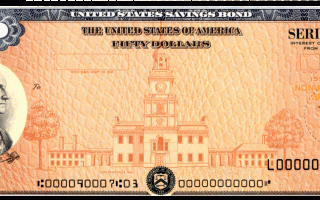
Series I Savings Bonds fit that description with a few caveats, which we’ll get into below.
Nearly Double-Digit Rates
As with most bonds, I bonds earn interest, the rate of which is largely determined by inflation. Right now, that rate is 9.62%. That rate will be applied to the six months following purchase, and then is reset for the remaining six months. Interest on I bonds is compounded on a semi-annual basis.
To buy I bonds, you’ll need to create an account at TreasuryDirect, a website run by the U.S. Department of the Treasury Bureau of the Fiscal Service. This is one of the negatives of buying I bonds: It’s another account to keep track of, and there’s no way to transfer the bonds to your brokerage (and no way to buy them via your brokerage, either).
Another potential negative is that you can only buy $10,000 worth of I bonds each calendar year, though that’s in addition to being able to use up to $5,000 per year of a federal tax refund to purchase the bonds. Depending on your financial situation, that might seem out of reach (in which case it’s not really a negative), or it might seem like a drop in the bucket. That is a per-person limit, so a household could purchase up to $10,000 a year per person, even for children.
At nearly 10% interest —with a decent chance of an increase in that rate in October of this year when the rate resets— I bonds are something of a no-brainer for:
- Money you’re sure you won’t need for the next 12 months.
- Money you’re earmarking for some purpose a year or so out, meaning it’s not appropriate for the stock market (because you run the risk of temporary capital impairment right when you need the funds).
But. (There’s always a but with investing.)
I bonds’ interest rates are based on the rate of inflation. This means that you’re never going to earn stock-market-like returns on the investment. You can maintain your purchasing power with your money, but you’re not going to increase it, or at least not by much.
This means that they really should be thought of as something to hold onto for the short term, and not something to roll over each year as they mature. You won’t drown with I bonds, but you won’t do much better than tread water with them. The stock market might throw you overboard now and then, but will always pull you back onto the boat. For longer-term investments, equities remain the best place to be.
Great for Retirees
Retirees have struggled to beat inflation using bonds over the past decade due to extremely low-interest rates. But I bonds pretty much guarantee that the fixed income portion of your retirement portfolio will at least match inflation.
I used WealthTrace’s financial planning software for individuals and found that for a 65-year-old retired couple, I bonds improve their chances of never running out of money (vs. regular treasuries) by 15%. This assumes both people purchase the maximum amount of I bonds allowed for five years.
Beats Stuffing it in A Mattress
Despite their issues, I bonds are something of a bright spot in what has been a pretty poor fixed-income landscape. After all, 2-year treasuries currently earn around 3.8%, and 10-years are at 3.4%. Investment grade corporate bonds, meanwhile, are at around 4.8%. None of those come close to beating inflation right now.
Nothing beats a bank account for liquidity: You can go to an ATM and get some cash, or use that bank account to pay your credit card bills each month. But if that bank account has a bigger balance than normal, and you’re already as invested in the stock market as you’re comfortable, I bonds could be a great alternative.
Read More:
Is There A Time When A Savings Account Is Best To Earn Interest?
Find Out the Market Value of Your Home
Here’s How to Cash Proof Your Retirement
Come back to what you love! Dollardig.com is the most reliable cash-back site on the web. Just sign up, click, shop, and get full cashback!
Read More

It’s a hard time to look for work in America, and many Americans are looking.…

If the company that you work for has a 401k, you should take advantage of…

Your life is going to change a lot after retirement. Of course, how drastically it…

For some people, New Year’s Day is just another day to make promises they probably…

Planning for retirement isn’t always easy. Often, you’ll have a few account options available to…


Most people know that the earlier they start saving for retirement, the better. But, life…
Comments