
The Saving Advice Forums - A classic personal finance community.

The disappearance of the middle class

Collapse
X
 
  • Filter
  • Time
  • Show
Clear All
new posts

  • The disappearance of the middle class

    If your anything like me, you have likely seen hundreds, if not thousands of news articles about the disappearance of the middle class. I read this article this morning and found it very interesting to say the least.

    It sure goes against the "death of the middle class" that you can't help but read about virtually nonstop in the media.

    Over the last few years, I’ve featured a series of posts analyzing the distribution of US household incomes by the shares of various income categories, see the most recent post here. In those posts I...


    Just interested to hear what others on the forum think of this article.
  • #2
    I agree with the basic premise of the article - that the middle class isn't disappearing. What I disagree with is how the classes are defined - according to the article, middle income earners are households with an income of 35,000 - 100,000 (2013 dollars) per year.

    Ask a 45 year old married couple dual income with a $110,000 household income - I bet they consider themselves middle class. Ask a married couple in their mid to late twenties, single earner, earning $32,000 per year - I bet they consider themselves middle class.

    I may be arguing over semantics - middle income vs. middle class.

    But I would tend to classify by assets, or net worth, rather than income.

    My opinion is that the vast majority of Americans are in the middle class.

    The "lower" class (in my opinion) has very few assets, probably a negative net worth, probably lives in rented housing, probably most income is in the form of government benefits.

    I don't know where the "upper" class starts in terms of net worth, but probably at least five million dollars. (There are a lot of middle class people retiring with a $1 - 2 million net worth.)

    In my opinion, the middle class is everyone in between. And, that's a lot of people.

    Of course there is a correlation between income and net worth. And of course, you can further divide the middle class into upper middle, solidly middle, and lower middle classes. But I would divide it something like this:

    Lower class - bottom 20% net worth
    Upper class - upper 10% of net worth
    Middle class - middle 70% of net worth, or almost everyone most of us on this board knows, and interacts with on a daily basis.

    Comment


    • #3
      Originally posted by Bob B. View Post
      I agree with the basic premise of the article - that the middle class isn't disappearing. What I disagree with is how the classes are defined - according to the article, middle income earners are households with an income of 35,000 - 100,000 (2013 dollars) per year.

      Ask a 45 year old married couple dual income with a $110,000 household income - I bet they consider themselves middle class. Ask a married couple in their mid to late twenties, single earner, earning $32,000 per year - I bet they consider themselves middle class.

      I may be arguing over semantics - middle income vs. middle class.

      But I would tend to classify by assets, or net worth, rather than income.

      My opinion is that the vast majority of Americans are in the middle class.

      The "lower" class (in my opinion) has very few assets, probably a negative net worth, probably lives in rented housing, probably most income is in the form of government benefits.

      I don't know where the "upper" class starts in terms of net worth, but probably at least five million dollars. (There are a lot of middle class people retiring with a $1 - 2 million net worth.)

      In my opinion, the middle class is everyone in between. And, that's a lot of people.

      Of course there is a correlation between income and net worth. And of course, you can further divide the middle class into upper middle, solidly middle, and lower middle classes. But I would divide it something like this:

      Lower class - bottom 20% net worth
      Upper class - upper 10% of net worth
      Middle class - middle 70% of net worth, or almost everyone most of us on this board knows, and interacts with on a daily basis.
      I believe I saw somewhere stating that the 1% club requires either a 400k/year household income or 8.3mil in net-worth to qualify..and this is where the upper class starts. At least my definition of upper class is maseratis in your drive way and living in million dollar houses (both are paid off). I don't consider a couple making 200k/year struggling with a 400k mortgage and a 200k worth of student loans upper class.

      So this leaves the middle class to be making between 32k-300k a year? Doesn't sound right..and I do believe there are many people who are one lay off from collecting food stamps despite making 300k/year. I am really not sure how the middle/working class system works due to a debt ridden society.
      Last edited by Singuy; 03-02-2015, 12:56 PM.

      Comment


      • #4
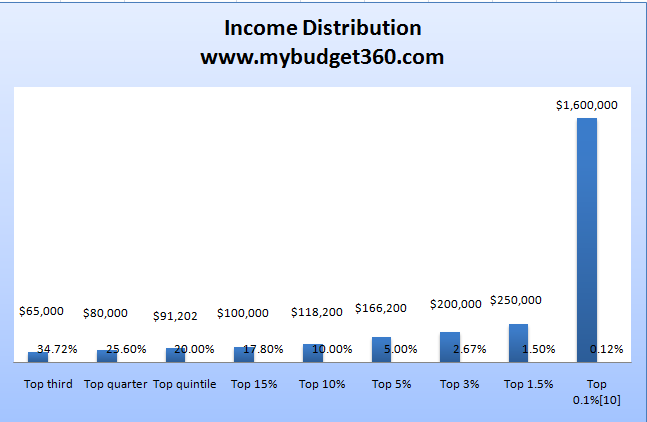
        Below is a good article on US incomes

        The bottom 25% made less than $25,000 and the upper 25% earn over $80,000, those between are the middle 50% of American incomes. To me, this is the core of the middle class.

        The median household income is $46,326
        The median dual income household income is $67,348
        The top 10% make over $118,200
        The top 5% make over $166,200
        The top 1.5% make over $250,000

        It made me laugh when both presidential candidates in the last election defined "middle class" as those making under $250,000 a year. Easy to get votes when 98.5% of voters then become "middle class".

        I think there are factors that make the discussion of what is middle class difficult, such as high cost of living areas and Americas love for living beyond her means.
        I definitely don't have the right answer for everyone as "middle class" is a very subjective term, but I find the topic interesting.

        Comment


        • #5
          Originally posted by Bob B. View Post
          I agree with the basic premise of the article - that the middle class isn't disappearing.
          I agree. Really, it isn't possible for the middle class to disappear. There will always be a range of income levels so some group is always going to fall in the middle of that range.

          What is generally meant by those articles is that because of stagnant wages and rising costs, the folks in the middle have been losing ground to those on the upper end. I think that's absolutely true. My wife and I have been victims of this ourselves.

          Basically, the rich have gotten richer while the folks in the middle have lost ground. Our net worth has grown over time but our income hasn't risen to match rising expenses.
          Steve

          * Despite the high cost of living, it remains very popular.
          * Why should I pay for my daughter's education when she already knows everything?
          * There are no shortcuts to anywhere worth going.

          Comment


          • #6
            That's the problem with trying to break up the salary range of the nation, which is an exponential curve, into three segments. Lots of ways to split it and none of them are totally fair.

            Comment


            • #7
              Originally posted by Bob B. View Post
              II would tend to classify by assets, or net worth, rather than income.
              I think income is much more important than net worth, especially when most net worth is tied up in real estate and retirement savings. It isn't money that is available for spending.

              Another thing that is often left out of the discussion, however, is geography. There is a huge difference between earning 100K and living in Manhattan and earning 100K and living in a small town in Kansas. Going strictly on income and putting those two families on equal footing would be wildly inaccurate.
              Steve

              * Despite the high cost of living, it remains very popular.
              * Why should I pay for my daughter's education when she already knows everything?
              * There are no shortcuts to anywhere worth going.

              Comment


              • #8
                Why do we try so hard to define the "middle class"?

                Comment


                • #9
                  Originally posted by tomhole View Post
                  Why do we try so hard to define the "middle class"?
                  I've often asked the same question. It seems to be largely a political concept. And people like to compare themselves to others and see how they're doing.
                  Steve

                  * Despite the high cost of living, it remains very popular.
                  * Why should I pay for my daughter's education when she already knows everything?
                  * There are no shortcuts to anywhere worth going.

                  Comment


                  • #10
                    Originally posted by disneysteve View Post
                    What is generally meant by those articles is that because of stagnant wages and rising costs, the folks in the middle have been losing ground to those on the upper end.
                    +1

                    Wage growth over the last 30 years is the real subject here.

                    If you want a real eye-opener- look at income distribution today compared to the 1950s.
                    seek knowledge, not answers
                    personal finance

                    Comment


                    • #11
                      I think everything revolves around 2 things in this country.

                      A. Healthcare
                      B. Oil (prices)

                      As DS notes, it isn't that the Middle Class has disappeared. . .it's just taht the middle class really values SECURITY over WEALTH and that in a moment's notice, because we are the only nation that let's people go bankrupt over an illness, it can all be taken away from you and you and your kids can be left homeless.

                      A lot of middle class workers feel that exposure, that was never there in years bygone.

                      Comment


                      • #12
                        I've seen the hype and have done a lot of reading on this too. From what I've gathered, the disappearance of the middle class is really about changes in lifestyle as dictated by increased productivity, rising expenses, and stagnant wage growth. A middle class family might make $100k as a year as a household where middle class is defined as an income level, but if their job/skillset ties them to a high cost of living area, then much larger portions of their income go to living expenses.

                        I was discussing this with my partner the other day about how our Grandparents were what we'd consider "middle class" back in their day.

                        All the men retired with company-paid pensions.

                        The wives raised children, and only once the children were much older, they worked part time at non-stressful jobs to earn some extra spending money and to kill boredom.

                        Their families owned two vehicles, they owned their homes and their land, and they were able to put away cash savings.

                        They all retired in their early 60's and most of them are now in their mid 80's, some even older. There were also large families, 3-5 children on each of the sides.

                        That's not the middle class I see today, in fact most "middle class" homes are dual-income now. Another post mentioned "security", and how that's been taken away, and I think this is part of it. Healthcare and retirement are now largely funded by employees themselves, most households cannot survive on one income, and raising children is now squeezed in between work and trying to take care of a home.

                        So while I don't think the middle class is disappearing, the definition of what it is, has changed. There's been a loss of opportunity and security, as well as an increas of lower income households, as well as an increase in households bringing in very serious dough in that top 1-3% range. It's like the old adage of shrinking McDonalds burgers...What was a large is now a medium and the price hasn't really changed!

                        To add some slice and dice-- Republicans love to refute that the middle class is disappearing on face value of the statement alone. They know the numbers, and they love to run their political platforms on supporting a middle class that's alive and well--but could do better--on the same policies that increase prices and stagnate income. It's a shell game. If you put "middle class" under a cup that represents income alone, things look fine. When you define middle class in terms of lifestyle, it becomes measured in distance from a financial edge which represents one's ability to survive in the face of adversity. I truly believe the middle class is much closer to that edge than ever before.

                        My own life as an example--college educated, and productivity in my industry is absolutely revolutionized compared to 10, 20, even 50 years ago, but I make the same middle class "wage" that my grandfather made 50 years ago without a college degree/formal education, AND without contributing to a retirement account, or monthly healthcare costs comparable to a mortgage of yesteryear.

                        Politicians LOVE the middle class-- because even the lower class in terms of income thinks they're up and coming middle-class-ers. At 98.5% of the population in terms of income spread, if that's how we define it, they'll support votes of politicians that support them. The other 1.5% - They're either buying the vote, or not voting at all.
                        Last edited by ua_guy; 03-04-2015, 06:48 AM.
                        History will judge the complicit.

                        Comment


                        • #13
                          Originally posted by ua_guy View Post
                          most households cannot survive on one income
                          I would debate this point. I think most households can't get by on one income and have all of the luxuries they want to have. I think it is quite possible for most to live on one income if they would forgo 250 cable channels, having the kids in 14 different activities, eating out 5 nights a week, taking exotic vacations, and every family member having an iPhone and iPad.
                          Steve

                          * Despite the high cost of living, it remains very popular.
                          * Why should I pay for my daughter's education when she already knows everything?
                          * There are no shortcuts to anywhere worth going.

                          Comment


                          • #14
                            Originally posted by disneysteve View Post
                            I would debate this point. I think most households can't get by on one income and have all of the luxuries they want to have. I think it is quite possible for most to live on one income if they would forgo 250 cable channels, having the kids in 14 different activities, eating out 5 nights a week, taking exotic vacations, and every family member having an iPhone and iPad.
                            Agreed. There's also the rise of "modern expense" and temptation compared to times past. But financial irresponsibility isn't a new concept. Don't forget to add in the expenses that aren't cable packages and iPads: Saving for retirement and health insurance for families with multiple children.

                            To counter that point, though, there are many financially responsible families who do not "keep up with the Jones'" who are tasked with following employment to areas where living isn't cheap. The struggle is real.
                            History will judge the complicit.

                            Comment


                            • #15
                              Originally posted by Goldy View Post
                              That's the problem with trying to break up the salary range of the nation, which is an exponential curve, into three segments. Lots of ways to split it and none of them are totally fair.
                              I totally agree.

                              Comment

                              Working...
                              X