The Saving Advice Forums - A classic personal finance community.

Is a 20% down-payment realistic today?

Collapse
X
 
  • Filter
  • Time
  • Show
Clear All
new posts

  • #16
    This isn't a popular or politically correct thing to say but the simple fact is that not everyone can or should own their own home. If you live in a costly housing market and earn a relatively low income, owning a home may be out of reach for you. The answer isn't to put down 0% and take an interest-only loan. The answer is don't buy. The problem is we keep being bombarded with the message that the "American Dream" is to own your home with a nice yard and a white picket fence. That dream turns out to be a nightmare for millions who buy a home when they really can't afford to do so.

    If you can't save up 20% and can't get a home where your payment (PITI) will be less than 28% of income (and or 2.5-3 times income), you probably shouldn't be buying.
    Steve

    * Despite the high cost of living, it remains very popular.
    * Why should I pay for my daughter's education when she already knows everything?
    * There are no shortcuts to anywhere worth going.

    Comment


    • #17
      Originally posted by disneysteve View Post
      Exactly what I was going to say. You aren't comparing apples to apples when you look at data from 1984 until now. The market has changed significantly.
      +2

      While it appears from the OP's numbers that the price of a median home has outpaced income increases, I've got a feeling the attributes of said median home are quite different.
      Last edited by feh; 05-15-2014, 06:46 AM.
      seek knowledge, not answers
      personal finance

      Comment


      • #18
        Originally posted by feh View Post
        +2

        While it appears from the OP's numbers that the price of a median home has outpaced income increases, I've got a feeling there attributes of said median home are quite different.
        I published an article in a national financial magazine years ago that addressed this topic. I'll have to dig it out. Off the top of my head, I think the stat I gave at the time was that the size of the average new home in 1990 was more than 2 times the size of the average new home in 1950. And at the same time, the average family size had gotten smaller.

        I know that the average home size continued to increase until just recently when it finally started to drop again in the past year or two.
        Steve

        * Despite the high cost of living, it remains very popular.
        * Why should I pay for my daughter's education when she already knows everything?
        * There are no shortcuts to anywhere worth going.

        Comment


        • #19
          I have put 20% down on each home purchase I have made. I think it is wise to put at least 20% down. I will admit that about 7% of first downpayment was gifted money (wedding) so that helped us save quicker than earned income, but we still chose to use it for a home vs trips, cars, or stuff.

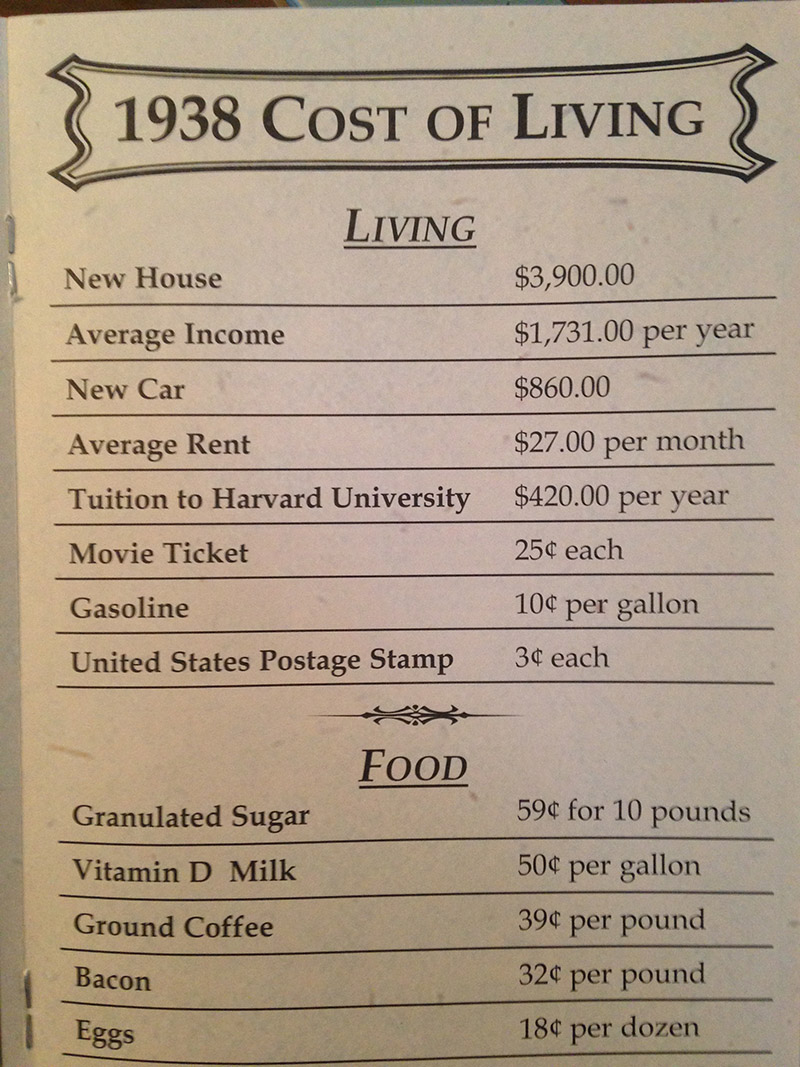
          here is a great article I read comparing the cost of life in 1938 to 2013. Its interesting to see the variance in inflation between items (college, homes, cars, fuel) and wages.


          Key takeaways for those that dont want to look at links.....

          In 1938 the average home was 2X the average income (single income)
          In 2013 the average home is almost 10X the average income. (still using single income but most households are duel income now just to keep up)


          In 1938 a new car was 1/3 the average persons income (cars were usually bought not loaned)
          In 2013 a new car is higher than the average single income (and auto loans are huge business)

          Inequality in our society is worse that 1938

          Comment


          • #20
            Originally posted by bigdaddybus View Post
            In 1938 a new car was 1/3 the average persons income (cars were usually bought not loaned)
            In 2013 a new car is higher than the average single income (and auto loans are huge business)

            Inequality in our society is worse that 1938
            Lies, damn lies, and statistics (Mark Twain)

            There are so many things wrong with looking at "averages". For example, the "average" income varies a lot depending on your age and especially on your education level. The average income of a male with a bachelor's degree is $60,500. Sorry but that's not less than the cost of a new car. Many more people have college degrees today so you need to look at stuff like that when comparing stats. And when we're talking about cars, we can have the same conversation as with houses. If people are looking for nicer and fancier cars, of course they will cost more, but that is totally a personal choice. I bought my last car in 2012. I paid a whopping $16,000. I earn over $100,000. So for folks whining and complaining that things are too expensive, my advice is to buy something cheaper that you can actually afford. The victim mentality in our society is pervasive.

            ETA: Here is a quote from a recent AP article on the car topic (sorry to hijack the housing thread but I think it is relevant).
            U.S. vehicle prices have hit a record high average of $31,252, up nearly $1,000 from the same time last year. High-end stereos, navigation systems, leather seats, and other new features that American car customers are adding have inflated the price, which experts say may not be sustainable. A change in interest rates could cause buyers to drop pricier options.
            Last edited by disneysteve; 05-15-2014, 08:50 AM.
            Steve

            * Despite the high cost of living, it remains very popular.
            * Why should I pay for my daughter's education when she already knows everything?
            * There are no shortcuts to anywhere worth going.

            Comment


            • #21
              Originally posted by disneysteve View Post
              I know that the average home size continued to increase until just recently when it finally started to drop again in the past year or two.


              For fun I looked up the house my dad grew up in 0-18yrs.
              the house I lived in from age 0-12 and then 12-18.
              Then I looked up the 2 homes my kids have lived in, 0-8 and our current home 8-13yrs old.

              My dad was raised in 1100 sq ft (3 kids), my mom in a 1000 sq ft (5 kids)
              I grew up in 1300 sq ft and 3340 sq ft (2 kids)
              My kids are living in 2200 and 4600 sq ft (4 kids)
              and my parents retired in a 12,000 sqft house for just them. lol, they grew up lower middle class and have been overcompensating ever since.

              So my family is living on the "bigger is better motto"

              Comment


              • #22
                Originally posted by disneysteve View Post
                Lies, damn lies, and statistics (Mark Twain)

                There are so many things wrong with looking at "averages". For example, the "average" income varies a lot depending on your age and especially on your education level. The average income of a male with a bachelor's degree is $60,500. Sorry but that's not less than the cost of a new car. Many more people have college degrees today so you need to look at stuff like that when comparing stats. And when we're talking about cars, we can have the same conversation as with houses. If people are looking for nicer and fancier cars, of course they will cost more, but that is totally a personal choice. I bought my last car in 2012. I paid a whopping $16,000. I earn over $100,000. So for folks whining and complaining that things are too expensive, my advice is to buy something cheaper that you can actually afford. The victim mentality in our society is pervasive.
                So are you saying that the median american wage is not roughly $27,000 a year? Average household makes around 50-52K? Those stats are pretty well documented.

                According to Social Security tax records for 2011:
                151,380,749 wage earners (had earnings in 2011)
                50 percent of US wage earners made less than or equal to the median wage, estimate to be $26,965
                66 percent of US wage earners made less than or equal to $41,211.36

                Sounds like you think Americans are wealthier than they are. I am glad the average male with a college degree makes good money, I am one of them
                Last edited by bigdaddybus; 05-15-2014, 08:39 AM.

                Comment


                • #23
                  Originally posted by disneysteve View Post
                  U.S. vehicle prices have hit a record high average of $31,252, up nearly $1,000 from the same time last year. High-end stereos, navigation systems, leather seats, and other new features that American car customers are adding have inflated the price, which experts say may not be sustainable. A change in interest rates could cause buyers to drop pricier options.
                  We bought a new vehicle in 2011 (worst decision ever, I will never buy new again, only used!) and didn't get any upgrades. No high end stereo, navigation system, or leather seats. Our only requirement was all wheel drive, since I'm a nurse and have to drive to work even if there is bad weather. I spent the entire day negotiating with the salespeople and still ended up paying about $30,000. We didn't get a high end or luxury vehicle, we just got a Nissan. All this to say that even used cars are getting increasingly more expensive to purchase.

                  Sorry to participate in highjacking the housing thread, but I just wanted to contribute to this conversation!

                  Comment


                  • #24
                    Originally posted by ladonnarosso View Post
                    I spent the entire day negotiating with the salespeople.
                    I'm sorry but this is just not a good idea. The only reason to negotiate with car salespeople is if you're buying used from a dealer. There are so many online options now (AAA, TrueCar, etc.) where you should be able to price out and get a firm written quote via email without stepping foot in the dealership, and you will almost always get a better price that way, or at least save yourself a big headache.

                    Comment


                    • #25
                      Whether or not someone can afford something is immaterial. If you can't afford it, don't buy it. If you keep thinking that you somehow have the right to homeownership or that you "deserve" it, you're in trouble. It's like being broke and getting a payday loan. Chances are you're digging yourself into a deeper hole.

                      What's wrong with renting? It's still 4 walls with a roof so you and your stuff can be protected from the elements. I was excited about my house for about a week. Now, it doesn't give me more enjoyment than the crappy apt I was renting before. So, I'm glad I only spent 1.5X my income on it. More disposable income to do the things I enjoy. Going on a nice Caribbean vacation in 3 weeks.

                      Comment


                      • #26
                        Originally posted by MonkeyMama View Post

                        --I have no idea why renting while you save up 20% is a bad thing.
                        We put down 20% but I didn't want to buy a house. But the cost of renting was actually more by $100-200 than owning a house in a certain price range. Not that that's apples to apples.

                        I don't regret owning our house, but as my wife realized last night, there she feels a "slave" to the house. When we were renting the maintenance both in time and cost was minimal. I grew up outside the United States where homeownership wasn't a big deal—most people rented. There seems to be an American mindset that you can't start having a family in a rented space (absolute hooey).

                        I don't mind being a homeowner. It's a good experience for me and I'm learning a lot. But I do feel we are wasting a lot of money on making a house a home—and we're frugal people.

                        Comment


                        • #27
                          siggy, in 1984 families sought homes they could afford. 1st home was small. A 'starter' home was plain Jane, 2/maybe 3 bdrms, 1 bthrm, no appliances, no cut out for a dishwasher, often older in need of an update trading sweat equity for $$$$. New builds were in the suburbs, need to commute, no landscaping, no grass, no patio, no fence, gravel driveway, no appliances, 1,400 sf, laminate flooring, ugly, particle board cupboards, cheapo aluminum siding and worst of all no services nearby. Young couples [DINKS] bought condos.

                          Comment


                          • #28
                            Originally posted by snafu View Post
                            siggy, in 1984 families sought homes they could afford. 1st home was small. A 'starter' home was plain Jane, 2/maybe 3 bdrms, 1 bthrm, no appliances, no cut out for a dishwasher, often older in need of an update trading sweat equity for $$$$. New builds were in the suburbs, need to commute, no landscaping, no grass, no patio, no fence, gravel driveway, no appliances, 1,400 sf, laminate flooring, ugly, particle board cupboards, cheapo aluminum siding and worst of all no services nearby. Young couples [DINKS] bought condos.
                            You pretty much described the house I grew up in, as well as my first home I bought when I was 25. We had a cut-out for the dishwasher, but it had wheels and one of those dual hose connectors that fit on the kitchen faucet.

                            Comment


                            • #29
                              Originally posted by JoeP View Post
                              You pretty much described the house I grew up in, as well as my first home I bought when I was 25. We had a cut-out for the dishwasher, but it had wheels and one of those dual hose connectors that fit on the kitchen faucet.
                              We bought our house in 1992. The previous owner had remodeled the kitchen and left a space for the dishwasher but they didn't have one. They actually kept the dog's cage in the space. We moved in in May 1994. We didn't get a dishwasher until summer of 1995. My wife was 7 or so months pregnant and was having trouble reaching the sink.
                              Steve

                              * Despite the high cost of living, it remains very popular.
                              * Why should I pay for my daughter's education when she already knows everything?
                              * There are no shortcuts to anywhere worth going.

                              Comment


                              • #30
                                Originally posted by snafu View Post
                                siggy, in 1984 families sought homes they could afford. 1st home was small. A 'starter' home was plain Jane, 2/maybe 3 bdrms, 1 bthrm, no appliances, no cut out for a dishwasher, often older in need of an update trading sweat equity for $$$$. New builds were in the suburbs, need to commute, no landscaping, no grass, no patio, no fence, gravel driveway, no appliances, 1,400 sf, laminate flooring, ugly, particle board cupboards, cheapo aluminum siding and worst of all no services nearby. Young couples [DINKS] bought condos.
                                Average home mortgage interest rates in the US in 1984 were somewhere north of 13% and higher than 14% in some cases.

                                That put a sizable dent in the size of homes and included features.

                                Buying power is simply less today, even with interest rates still hovering near historical lows. More people are more educated than ever and working more than ever, yet incomes haven't kept in step with rising prices, real-estate being one of the most volatile (and also variable by geographic region).

                                For those that don't know what "DINKS" stands for in Snafu's post: Double Income No Kids.
                                History will judge the complicit.

                                Comment

                                Working...
                                X